top of page
Sirachai Shin
Arunrugstichai
p h o t o j o u r n a l i s t

How Thailand became a world leader in edible insects
 Jars of edible insects are arranged to showcase their diversity in the kitchen of Akkee, a Michelin-starred restaurant in the outskirts of Bangkok that utilizes a variety of seasonal insects in their dishes. |  A worker provides water to African crickets (Gryllus bimaculatus) at Srichana Cricket Farms in Rayong, Thailand. |  African crickets (Gryllus bimaculatus) are raised in containment ponds at Srichana Cricket Farm in Rayong, Thailand. |
|---|---|---|
 Workers shake house crickets (Acheta domesticus) from milk cartons inside a containment pond before a harvest at Siam Bugs Farm in Pattaya City, Chonburi, Thailand. |  At Akkee, a fine-dining restaurant with one Michelin star, customers can enjoy a variety of seasonal insects in their dishes. |  A live African cricket (Gryllus bimaculatus) is seen on the chef's suit of Sittikorn Chantop, the head chef and owner of Akkee. |
 Sittikorn Chantop (right) and other staff prepare various insects to be used as ingredients in the kitchen of Akkee. |  A customer at Akkee eats a deep-fried sago worm, larvae of Asian palm weevil (Rhynchophorus ferrugineus) beetles. | 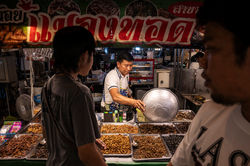 At a night market in Bangkok, Thailand, food stall vendors sell various deep-fried insects. |
 Exofood, a company that promotes innovation and education in the edible insect industry, sells various products at its headquarters in Bangkok, Thailand. |  A worker provides formula meal for House crickets (Acheta domesticus) that are being raised in vertical containment ponds at the facility of Siam Bugs Farm in Pattaya City, Chonburi, Thailand. |  House crickets (Acheta domesticus) are raised in vertical containment ponds at Siam Bugs Farm in Pattaya City, Chonburi, Thailand. The rice-like pellets are freshly laid eggs. |
bottom of page