top of page
Sirachai Shin
Arunrugstichai
p h o t o j o u r n a l i s t

SDN Portfolio Review
 |  Ignasius Blikololong, a senior lamafa and boat builder, speaks with Alya Beding, a young Lamaleran studying in the city, about the “Way of the Ancestors” as twilight approaches on the beach of Lembata Island, East Nusa Tenggara, Indonesia. The Way of the Ancestors is a cultural code that guides Lamaleran life and whaling traditions, reflecting the community's relationships with the sea. | 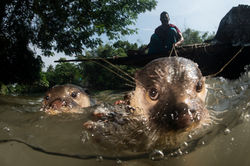 River otters investigate the camera while cooling down from midday heat and being fed by Shyam, a Bangladeshi fisher, after a night of fishing in the forest canals of Khulna, Bangladesh. Fishers here train otters to help chase fish into their nets, a practice passed down through generations. Though its origins are not clearly documented, the tradition in Bangladesh is believed to be more than 200 years old, reflecting the long histories of many fishing cultures across Asia that span centuries. |
|---|---|---|
 Ko Ryou Jin, one of the new generation of Haenyeo, continues the diving tradition passed down by her mother, the chief of the Pyeongdae Haenyeo Association, and now plays a growing leadership role in the Haenyeo community of Pyeongdae on Jeju Island, South Korea. The Haenyeo culture, recognized by UNESCO as an Intangible Cultural Heritage of Humanity, reflects a centuries-old tradition of female free divers who harvest seafood without breathing equipment. |  Bae, a Li fisherman, dives into murky water to retrieve a large rock used to anchor a Li, a wooden fish trap built in the waterfalls of Si Phan Don, Champasak, Laos. During the dry season, when the Mekong’s waterfalls and channels become accessible, families and community members work together to construct these traps before the rains arrive. The fishing method is closely tied to the seasonal rhythms of this unique landscape of the Mekong River. |  A group of local tourists gather to take photographs before departing from Jinshan Harbour to witness traditional fire fishing at sea at night, New Taipei, Taiwan. The practice, once in decline, is now being reintroduced through tourism and educational programs initiated by the firefishers and community members. In 2024, more than 5,000 visitors joined these trips, with participation doubling since the program’s launch in 2023 and supporting the return of additional fire fishing boats. |
 Crimson blood bursts from the wounds of a Spinner dolphin harpooned by a Lamaleran fisher, Lembata Island, East Nusa Tenggara, Indonesia. The Lamaleran are traditional harpooners who hunt large marine animals that pass seasonally through the Savu Sea during their migrations. For six centuries, the community has depended almost entirely on these animals for protein, with much of the meat preserved and dried to last through the year. |  A River otter in a bamboo box touches a fisher’s hand during a feeding session at dusk before heading out to fish in the forest canals at night, Khulna, Bangladesh. Otters are regarded as members of the fishing household rather than pets, as fishers depend on their trained otters to guide fish into nets. The practice reflects a long partnership between humans and animals, with fishing skills passed down through generations in both families of fishers and their otters. |  Diners watch a film projection while listening to the story of a real Haenyeo at Haenyeo Kitchen, a restaurant that combines fine dining and storytelling to introduce the culture of Jeju’s female divers, Jeju Island, South Korea. By turning the divers’ experiences into an immersive dining event, the concept reflects growing efforts by private businesses to bring new visibility and economic value to Haenyeo culture, demonstrating how creative endeavors can play a role in cultural conservation. |
 Laotian fishers traverse between Li, traditional wooden weirs that trap migrating fish swept by the powerful currents of the rainy season at Khon Falls, the largest series of cascading waterfalls in Southeast Asia, located in Si Phan Don, the riverine archipelago of the Mekong River in Champasak, Laos. Very little is documented about the history of this fishing technique in the region, but the practice is legally banned, leaving only a few remaining traps in remote locations. |  The Fuji 268, a traditional fire fishing boat, ignites a burst of flame to startle schools of sardines in coastal waters off Jinshan Harbour, New Taipei, Taiwan. The technique involves igniting a sudden fireball created by acetylene gas produced from calcium carbide, a practice recognized as a national cultural heritage of Taiwan. In 2023, Fuji 268 was the last remaining fire fishing boat in operation, but with renewed interest driven by tourism, another vessel returned to operation in 2024. |  A dead orca is seen on the beach of Lamalera village while the villager gather to watch a big bounty, Lembata Island, East Nusa Tenggara, Indonesia. In exception of the sperm whale, the orca is one of the largest preys the Lamaleran catch, which is not commonly caught and is treated with respect. According to the Lamalera custom, the orca will be left on the beach overnight, a special treatment that differs from most other catches. |
 River otters crawl through the mud during a night fishing session before dawn, Khulna, Bangladesh. Trained otters help corral fish and other aquatic animals toward the fishers' nets. They are treated as working partners, and a family of otters typically receives a share of the catch equivalent to one fisher. In the past, there were several hundred otter fishing crews, but today only six remain active as habitat degradation, pollution, and modern fishing gear drive them toward disappearance. |  A Haenyeo catches an octopus in a shallow kelp bed on a rocky reef, Jeju Island, South Korea. Octopus is a prized but elusive catch that requires skill and agility to harvest. For centuries, Haenyeo have rotated harvesting grounds, changed target species with the seasons, avoided catching undersized animals, and kept detailed records of their daily catches to guide their decisions. Together, these practices form an effective traditional system of fisheries management. |  Various river fishes are washed by the raging currents onto Li, traditional bamboo weirs, during their migration in the rainy season, Champasak, Laos. The Lower Mekong Basin supports the world’s largest inland fishery, sustaining millions of people who depend on migrating river fish for food and livelihoods. Yet fish stocks across the Mekong are declining as river habitats deteriorate under hydropower development and environmental change, compounded by overexploitation from modern fishing gear. |
 People gather at a seafood vendor during an auction at Kanziding Fish Market, a major hub for seafood trade in Keelung, Taiwan. Operating one of the world’s largest distant-water fishing fleets, second only to China's, Taiwan relies on seafood caught overseas to meet 95% of domestic demand. The catch moving through the market reflects this shift, with much of it sourced from distant waters rather than the island’s depleting coastal fisheries. |  The skull of a sperm whale rests on the rocky beach of Lamalera village beneath the Milky Way, Lembata Island, East Nusa Tenggara, Indonesia. For the Lamaleran, sperm whales are the most culturally important catch and are often regarded as ancestral beings returning from the sea to feed the community in a harsh landscape where agriculture is not feasible. |  Three-week-old unweaned otter pups are fed formula milk, Khulna, Bangladesh. Fishers in the region breed and raise domesticated otters, keeping family registries to prevent inbreeding. According to a recently published report by the IUCN Otter Specialist Group, otters raised by fishing families have been observed to survive well when returned to the wild, drawing interest from conservationists about the potential role of these communities in future captive breeding and conservation programs. |
 Park Suk-Hee, the Chief Haenyeo of Pyeongdae, emerges in her wetsuit from the Haenyeo Association building after a day of fishing that can last up to five hours in the cool waters along the temperate rocky shores of Jeju Island, South Korea. Murals painted by local artists with government support decorate the building, reflecting various efforts to celebrate and sustain the tradition, including government-funded training schools for younger divers and collaborations with marine biologists. |  A massive construction site for a new water gate of the Don Sadam hydroelectric dam is illuminated at night in Champasak, Laos. Local residents, particularly small-scale fishing communities, worry about the cumulative impacts of a growing network of hydroelectric dams along the Mekong River on the ecology and fisheries that sustain their livelihoods, even as nearby villages continue to experience frequent electricity blackouts. |  People crowd the narrow streets of Kanziding Fish Market, where buyers, vendors, and visitors move through one of the busiest Taiwanese seafood markets, Keelung, Taiwan. Operating through the night, the market serves as a focal point of local food culture, where seafood remains central to daily life despite growing dependence on imported supply. |
 |  The head and fins of a Spottail shark (Carcharhinus sorrah) with the body removed are displayed on a metal table at a fish landing site, Ranong, Thailand. Sharks and rays, collectively known as elasmobranchs, are among the most threatened groups of vertebrates globally due to overexploitation through fishing and trade. |  A Bottlenose wedgefish (Rhynchobatus australiae) glides over shallow sandy seafloor as a school of Cobia (Rachycentron canadum) swims nearby at Koh Racha Island, Phuket, Thailand. Wedgefishes are among the world’s most threatened marine fishes, with 10 of the 11 extant species in the family Rhinidae assessed as Critically Endangered by the IUCN Shark Specialist Group, following steep population declines driven by intense exploitation across much of their distribution range. |
 A fleet of industrial trawlers shelters in a harbor during a rainstorm, Myeik, Tanintharyi Region, Myanmar, August 14, 2019. Mixed-species fisheries using non-selective industrial gears, including trawls and purse seines, are widely documented as a significant source of shark and ray mortality, in some regions accounting for catches that rival or exceed those of targeted shark fisheries. |  Dismembered bodies of Spinetail devil rays (Mobula mobular) are laid on the street prior to processing to extract gill rakers at a ray processing facility, Myeik, Tanintharyi Region, Myanmar. Listed as Endangered on the IUCN Red List and regulated under CITES, devil rays of the family Mobulidae continue to be caught for local consumption and international export, with Myanmar identified as a major source and global hotspot for devil ray fisheries, according to a recent study. |  A dead Whale shark (Rhincodon typus) killed as bycatch in non-selective industrial fishing gear is lifted with heavy machinery for burial following a necropsy conducted by veterinarians from Thailand’s Department of Marine and Coastal Resources at Tarutao National Park, Satun, Thailand. Although whale sharks are legally protected in Thailand and listed as Endangered on the IUCN Red List, incidental capture in non-selective fisheries continues to pose a significant risk to the species. |
 An old Sawfish (Pristis sp.) rostrum is displayed at the Museum of Fisheries, Kasetsart University, Bangkok, Thailand. Sawfishes are among the most threatened elasmobranchs, with all five extant species listed as Endangered or Critically Endangered on the IUCN Red List following severe global declines. With no confirmed records from Thai waters for more than 40 years, sawfishes are now considered locally extirpated by Thai researchers. |  Ichthyologists work on freshly collected rays to be preserved as taxonomic specimens at the Museum of Fisheries, Kasetsart University, Bangkok, Thailand. Taxonomic studies such as this contribute baseline scientific information on elasmobranch diversity in the region, addressing long-standing gaps in species identification and documentation, particularly for rays, which have historically received less research attention than sharks. |  A SCUBA diver approaches a rarely observed aggregation of hundreds of Bluespotted maskrays (Neotrygon caeruleopunctata) on the sandy seafloor at Mu Koh Similan National Park, Phang Nga, Thailand. Thai marine scientists have speculated that these aggregations may be linked to reproductive behavior. Observations such as this contribute to global efforts led by the IUCN Shark Specialist Group to identify Important Shark and Ray Areas (ISRA), which increasingly rely on reports from SCUBA divers. |
 A newborn Blacktip reef shark (Carcharhinus melanopterus) investigates a baited remote underwater video (BRUV) unit deployed in shallow water at Maya Bay, Koh Phi Phi Leh Island, Hat Noppharat Thara–Mu Koh Phi Phi National Park, Krabi, Thailand. Following the closure of the bay to mass tourism in 2018, researchers documented repeated use of the lagoon as a pupping area, with blacktip reef sharks returning annually, leading to its designation as an Important Shark and Ray Area in 2024. |  An aquarist holds a glass jar containing an embryo of an Indo-Pacific leopard shark (Stegostoma tigrinum) with its egg case removed, part of a captive-breeding experiment at Aquaria Phuket, Phuket, Thailand. Since late 2023, the program has produced more than 50 pups of this Endangered species and contributes to the StAR Project Thailand (Stegostoma tigrinum Augmentation and Recovery), a collaborative initiative exploring population recovery through captive breeding and release. |
bottom of page